Saturday, June 22, 2013

Right Now: Ian 4 1/2 years

You continue to amaze me everyday and especially when you are so kind or you show your gentle personality to me. You are so caring at times that it melts me.

Your favorite movie lately: the Lorax: Larry boy - Veggie Tales

Your favorite food: Mac'n Cheese or green peppers and hummus OR PB&J

Your favorite pajamas: anything superhero (continues to be)

Your favorite song: Skillet's "Superhero" song - you have begun to like Toby Mac
      You are now more apt to sing song and get up and dance!

You love to "race" anything (most everything is a competition to you) and to play outside any chance you have. You are hilarious and ask for "special things". 

You look forward to playing with our neighbor Cameron any chance you get.

You enjoy: 
* watering flowers, 
* playing the Wii (especially boxing)
* going to any friend's house
* swimming (reluctant sometimes but learning)
* photography-taking pictures
* running - you just ran your (second race!) one full mile in 10:30 minutes!


Sunday, June 16, 2013

Travel Personality: I am a Centric Venturer

Centric Venturer

By definition, you fit between venturers and authentics but with a leaning towards the venturer side. Compared to other groups, you have lots of company. Three out of ten travelers (30%) place in your group, making you one of the largest segments of travelers. As a result, the majority of travel providers-airlines, resorts, rental car companies, tour operators, cruise lines, and others- place you at the top of their list of persons they want to reach and motivate to travel.

Top 30 Destinations for Centric-Venturers
U.S. Destinations
International Destinations
Your significance lies not just in how many people are like you, however. It also grows out of the fact that you are easier to motivate to take a trip or buy a product than the personalities that lie more on the extremes on either side of you. Venturers tend to ignore advertising. Authentics (at the opposite end of the scale) pay attention to advertising but their commitment to a regimen and daily routine makes it more difficult to change their habits and motivate them to take a trip. In contrast, you are more flexible and adaptable, with a willingness to sample new destinations if a travel promoter presents enticing advertising.
It would be easy to assume that you are simply an “average” personality and do not go to extremes on most things. This assumption, however, would cover over your much more unique personality characteristics and behaviors. More than other groups, you use mixed transportation modes for leisure travel. In the same year, you are likely to fly to one or two destinations and drive to a couple of others. In contrast, your counterparts prefer either to fly (venturers) or drive (authentics). Although air travel saves tremendous amounts of time when the distances are great, the convenience of auto travel (take everything that you want with you and leave when you want to), along with the ability to move at your own pace provides its own inherent interest.
Unlike venturers, you prefer at least a modest selection of good hotels and some quality commercial development before you visit an area. A good bed in a nice hotel, food that can be trusted, and a transportation network that can help you get around are what you consider to be basic necessities that you would like to see firmly in place before you visit. But, when over-commercialization sets in, signified by many souvenir shops, the intrusion of fast food outlets, and the diesel smell from too many tourist buses, you will move on to some other place that has not yet lost its qualities of freshness and uniqueness. The kinds of things that you like to buy on trips to foreign lands are the products that various countries specialize in as part of their national heritage. Thus, wool sweaters and skirts in Scotland or England; crystal in England, Germany or Scandinavia; pottery and silver in Mexico; or semiprecious stones from various countries around the world serve not only as reminders of a great vacation, but they can be used when you return home.
The great capitals of Europe have long been favorites, but some of these now seem overcrowded, far too expensive, and unfriendly in how local citizens treat tourists. Therefore, when you go to Europe you might visit smaller towns and enjoy leisurely drives through the countryside. And, when you go into villages, you particularly enjoy staying at quaint little bed and breakfasts (B&Bs) in contrast to well known hotels.
The diversity of the kinds of places that would be of interest to you opens up many more travel destinations of potential interest than is true for either venturers or authentics. You could enjoy a cruise in the Greek Isles, a car trip through gold mining ghost towns in California, or a shopping spree in New York City equally well. You will probably return to a place that you particularly like every two to four years, interspersing other new destinations (for you) in between. In some respects, you can have the most satisfying travel experiences because of your ability to absorb, and like, such different types of places. If you follow the typical pattern for your personality, you travel both independently (probably with a spouse or a friend) and occasionally take a fully escorted tour. This might include international tours and domestic to see New England’s fall colors, visit Southern mansions, or follow historic routes as part of a tour group. Depending upon your age, the Elderhostel program is largely made up of your type.
Cruising has experienced strong growth in recent years, thanks to the fact that you believe that the experience is not as confining as in the past. You have decided that it is affordable and more interesting than you ever thought. And, very important, it’s so easy and comfortable because your hotel room goes with you wherever you are and you don’t have to pack and unpack every day. You may also own a time share, the concept of owning one or two weeks of vacation time in a condo in a resort area. Time shares tend to offer excuses for travel and most of these owners venture forth regularly.
You have mixed media habits, combining both TV and reading. You enjoy quite a few shows on TV, read an occasional book, and some of the popular magazines.
In summary, you are part of a group that is very important to the travel industry, including destinations, airlines, hotels and restaurants. And, because you are generally easier to motivate for travel through advertising and are willing to visit a variety of destinations, most travel companies desperately try to focus on you and your needs. They offer lots of special deals and incentives to get you to travel. You use mixed modes of transportation to get there, tend to return to a place only if you especially like it but no sooner than three to four years, and you also mix up the kinds of lodging that you use. On the same trip you might stay at a three or four star hotel, an economy/budget motel, and a B&B.

Saturday, June 1, 2013

Boys & Learning - shared from a blog - 3 Boys & a Dog

Studies show there are real differences between boys and girls in terms of brain chemistry, maturation and how they learn best.  Technologies such as PET scans and MRIs have already found “at least 100 differences in male and female brains,” and there are likely more discoveries to come.
The following information uncovers some key insights into boys and how they learn:
Reasoning
Brain-based research shows that there are major differences between boys and girls in terms of reasoning and brain development, which leads to differences in general understanding of concepts as well as test-taking abilities.
  • Boys “tend toward symbolic texts, diagrams, and graphs” that “stimulate the right hemisphere, which is where many boys are more developed.”
  • They typically use abstract and deductive reasoning to reach conclusions, meaning that they are able to learn a general concept and then apply that concept to other individual cases.
  • Boys’ proficiency in deductive reasoning leads to greater success on multiple choice tests, particularly those where answering questions quickly is an advantage, like the SAT.
Movement
In order to learn most effectively, boys must stay active, engaged and motivated.
  • Staying active is an integral piece of effective learning for boys. “Movement seems to help boys not only stimulate their brains, but also manage and relieve impulsive behavior.”
  • Movement increases blood flow to the limbic region of the brain, allowing boys to process emotions and reduce stress.
  • “Physical exercise is essential for… boys.  It helps calm them, helps them sleep at night, and helps them perform learning tasks.”
Structure
A highly structured and action-packed day keeps boys’ minds alert and active.
  • Daily structure helps stimulate motivation, goal-orientation and time management skills.  In fact, the highly structured, full-day schedules of top boarding schools and military academies can be particularly beneficial
  • Task-oriented work and active interaction with learning materials increase the amount of information absorbed by boys’ brains.
  • A structured plan gives a boy’s brain a direct route to a goal, managing stimulation from other sources and increasing focus.
  • Calendars can be useful tools for boys since they provide visual and spatial representations of what they need to accomplish and how much time they have to complete the task.
Motivation
Boys tend to get bored more easily than girls.
  • The male brain literally requires a “recharge” between tasks, meaning that the brain goes into a rest state before moving on to something new.
  • “Boys require more and varying stimulants to keep them attentive” and to decrease the length of time that the brain is at rest.
  • Focusing on a goal maintains boys’ concentration and paves the way for success both in school and in life beyond the classroom.
Teams
Both boys and girls can benefit from working on teams through learning about cooperation and teamwork.
  • Boys differ from girls because they tend to “[pick] leaders quickly and [focus] right away on goal orientation.”
  • When supervised carefully, teams can be used to promote healthy competition, which often serves as strong motivation for boys to learn and succeed.
  • “Boys tend to work out codes among themselves and within their own cognitive processes, and rely on coded language to communicate,” which strengthens the bond within a team, while increasing learning through the use of symbolism and abstract thinking.
Boys Do Learn Differently
In summary, boys follow a unique learning curve, one that can be significantly enhanced in an environment that appreciates the differences between genders.  A setting that recognizes the cognitive, emotional and social processes which motivate boys to reach their full potential is the optimal learning environment for boys.

Right Now: Eli 8 months!

Mr. Eli you are such a joy! And such a great baby!

* you're officially crawling and picking it so quickly beyond the army crawl
* you're smiling usually always from ear to ear unless you're too tired or hungry!
* your arms begin flailing when you see anything remotely that you think must be eaten when you're hungry...
* you have such a sweet, cuddly nature to you
* you lay down usually after rubbing your eyes and I often place your blanket between you & myself and you dive your head into it - that let's me know that you are definitely tired, sometimes I sway with you a little and then I lay you down (you immediately roll over, grab the blanket and you make sure that you have your pacy)
* you do pretty well with vegetables, of course you like fruits, you're drinking less of your bottle it seems
* you completely LOVE Ian and now that you are mobile you try to get to any of his things as fast as you can before we get you
* you love to smack your hand on your chair tray and listen to the noises you make
* you do say "momma & dadda" at times but you don't seem to know what it means yet
* you started to imitate us waving...and clapping somewhat
* you can sit up easier now
* you are just sooooo precious


Pinterest - yes I did it

I joined the Pinterest world about two months ago...and yes it is awesome and yes I love a lot of things and yes sometimes I just enjoying pinning but I also pin things that I WILL do....I told myself that in the beginning. Don't pin it if you're not gonna do it at some point.

So cheers to inspiration....the latest pins...Allowing Myself.....

to organize-rooms


to foster exploration


to create

the To-Do list: Weekend

As much as I love writing these down - it's just easier to type.

* balance cash-flow from May
* blog Eli's firsts: sitting up, crawling dates, momma & dadda, first parade & Strawberry festival
* letters to boys now
* blog Eli's 8 months
* look up Kroger, Target deals
* pick up--milk, formula, wipes, olive oil, spray for insects on roses
* pick more ROSES!
* look up Rose Gardening & Care
* send Kaleb present, sent Matthew present, send anniversary card to brother & sis-in-law
* drink lots of water
* load pictures of Strawberry festival
* think about Father's Day stuff

Tuesday, May 28, 2013

Teaching child how to swim

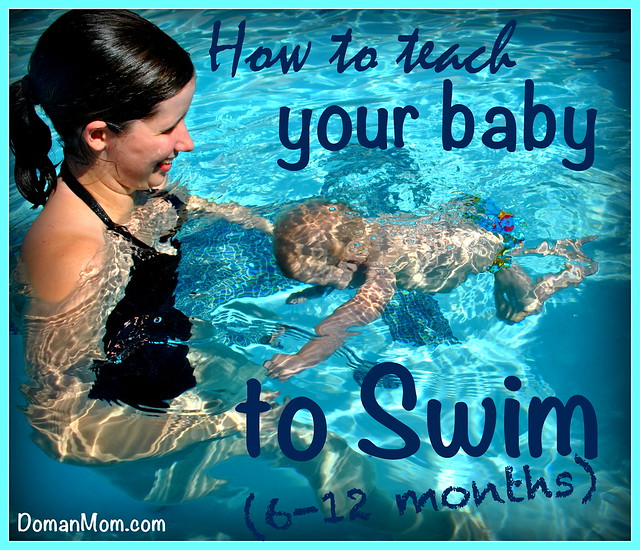
How to Teach Your Baby to Swim
Summer officially began yesterday, but for many of us “summer” has been in swing for weeks or even months now, which hopefully means lots and lots of beneficial swimming!
Our swimming program has been on again, off again since April, but lately has been going great with fabulous progress from both of my boys (ages 1 and 7). In this post, I would like to share with you the exercises I have been using with Damien (12 months) over the past few weeks to teach him how to swim!
How to Teach Your Baby to Swim
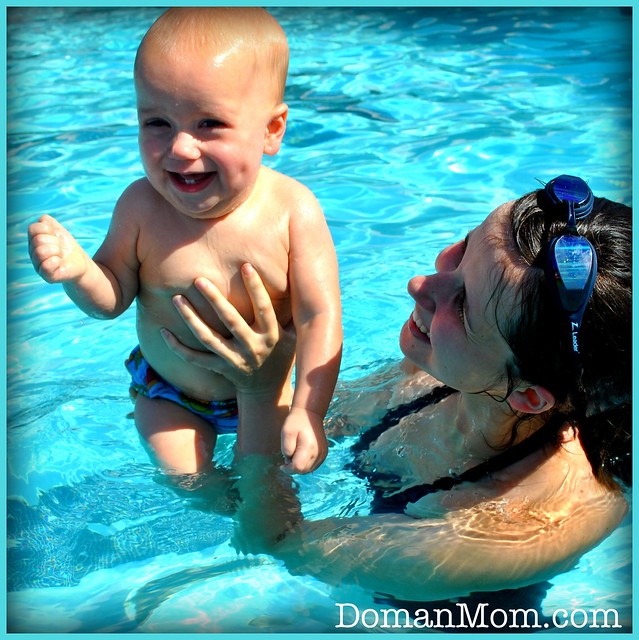
He loves to swim!
I use the techniques as outlined in the Doman book How to Teach Your Baby to Swim – Birth to Age 6. A little about this program:
  • It is not just a “water introduction” program as most “swimming lessons” are for this age. It is actually about teaching your baby to swim, by themselves, beginning at birth or any time thereafter (newborns are born knowing how to swim).
  • The program is gentle and joyous! No aggressive, cry-it-out techniques here.
  • The program emphasizes learning swimming skills, water safety, water hygiene, and bonding with parents.
This 6-12 month old program is the second level of the Doman swimming program (first level is 0-6 months). Some prerequisites to this level of the program:
  • Is ideally familiar with and accustomed to water and pool.
  • Can hold breath underwater
There are a lot more things covered in the first level of the program, but if you have an older baby and are just now beginning, you can jump right into this level of exercises after you first work on getting your baby comfortable in water and knowing how to hold their breath underwater. Some tips for achieving that are found below!
Are you ready for the techniques? Here are some of the exercises we do:
How to Teach Your Baby to Swim
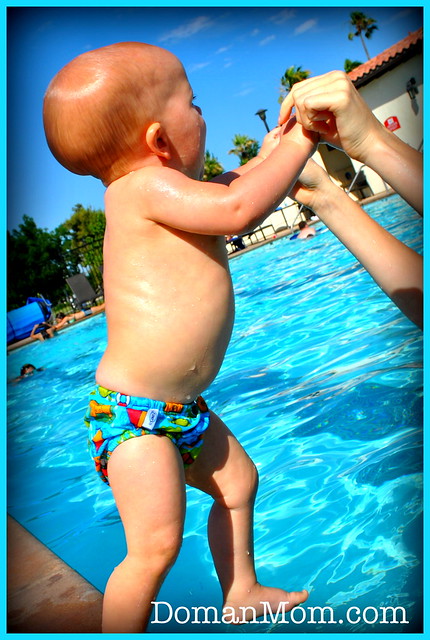
1. Jumping into the pool
This is an important exercise as it is not only laying the foundation for diving later on, but you are also teaching your baby how to safely enter the pool. It’s also an awful lot of fun!
Key: Teach baby to only enter pool with parent!
You can do this exercise by first having baby sit at the edge of the pool. Teach him that mommy always goes in first and he must wait. They’re never too young to understand this!Once you are ready, give him permission – “Ok! 1,2,3, jump!” Whatever wording you choose, be consistent and always say that same phrase.
In the beginning you will need to have him hold your fingers with his hands and very gently pull him in. If he is accustomed to going underwater, let him jump in and go under and then pull him up to the surface or let him kick and swim up to the surface.
Beginners: If he’s not yet accustomed to going underwater, just let him go in chin deep and then pull him back up to yourself. Gradually go deeper under as he learns and becomes comfortable!
How to Teach Your Baby to Swim
Jumping from standing
Some alterations of this exercise:
  • Jump in from sitting without holding parent’s fingers
  • Jump in from standing position with or without holding parent’s fingers
Tip: Continue to hold your baby’s fingers until you feel he is very well balanced – slipping is easy and can be dangerous
How to Teach Your Baby To Swim
Playing together underwater
2. Blowing bubbles, bobbing up and down, going underwater together
Blowing bubbles in the water is a great way to teach your baby to hold his breath if he’s not yet accustomed to it. It will teach him to blow out, not breath in, while his mouth is underwater, and will also help him to get comfortable with his face in the water. Babies love to mimic so this is always a lot of fun!
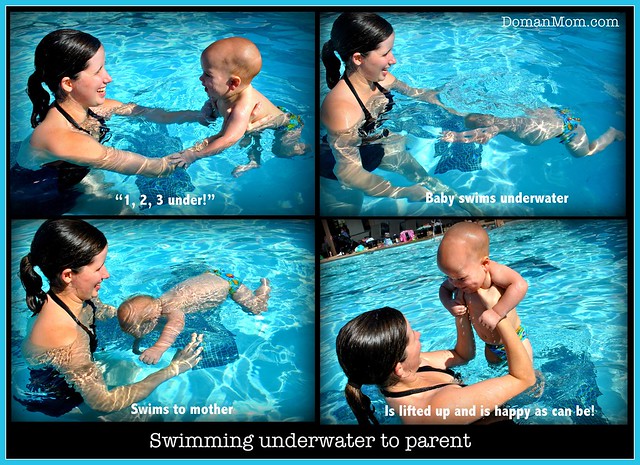
Bobbing up and down is another way to slowly introduce your child to holding his breath. Think of a phrase to use, such as “1,2,3, under!” that means he is about to go under the water, and use it every time without fail!
Always tell your baby when he is about to go under (either a little or fully submerged). He will learn what the phrase means and will hold his breath in anticipation.
At first simply bob him up and down only to chin deep. Keep it fun and joyous! Gradually, over the course of time, get deeper and deeper, first getting just his mouth a little wet with each bob, then submerging his entire mouth, then up past his nose, finally you will get to where his entire face and then entire body goes under with each bob.
Read your baby’s cues – introduce steps gradually and don’t continue if your baby isn’t enjoying himself!
A final exercise in learning to hold his breath will be to go underwater together completely. Do this for just a split second at first and you will gradually be able to stay under longer. Make it fun!
How to Teach Your Baby to Swim
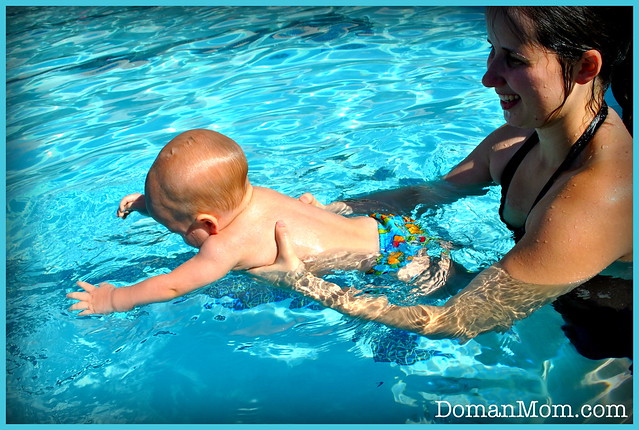
3. Passing underwater
Once your baby is comfortable holding his breath underwater, you can begin to teach him the swimming motions by passing him under the water. Grasp his sides as in the picture above and hold him horizontally in the water. You can either hold him straight out in front of you (as above) or sideways in front of your, or by your side. Then give him to phrase (“1,2,3, under!”) and put him underwater while moving him through the water. Encourage him to kick, kick, kick! This will teach him the forward motions of swimming. As he gets used to this, briefly let him go while you do this exercise.
How to Teach Your Baby to Swim
4. Swimming independently underwater
Once your baby is comfortable and confident underwater, he can begin to truly swim! Start by doing the bobbing up and down exercise or the passing underwater exercise, but briefly let go of him while he is underwater. This may startle him at first to feel his own weight floating in the water without your hands supporting him! Just begin slowly and gradually, as with everything.
Next begin to walk backwards in the pool while holding baby by his sides in front of you(see above picture). Give him the signal that he is about to go under (“1, 2, 3, under!”) and let him go. Hold your arms out for him to swim to you. Babies instinctually know how to swim! He may be uncoordinated at first but will get the hang of it quickly.
If he doesn’t fully swim to you, pull him towards you and then lift him out of the water.Praise him profusely! Begin with just split second swim sessions and gradually lengthen the time baby stays underwater as you sense his capabilities.
Walking backwards before you let him go under creates a current and will make it easier for baby to swim to you!
Alterations of this exercise:
  • Have baby swim to you while you are standing still (instead of walking backwards first)
  • Have baby swim between two parents or between a parent and sibling
  • Have baby swim in front of you or beside you (this way you can “push” him through the water before letting him go, giving him a boost)
  • Have baby sit on a stair step or hold onto the ladder or edge and then jump in and swim to you
How to Teach Your Baby to Swim
Back floating is the only thing about swimming he doesn’t yet enjoy
5. Floating on back
By being able to float on their backs, babies can learn to swim, flip over to catch a breath(and/or rest), swim some more, and then catch another breath and continue in this pattern. Most babies will be able to float on their backs long before they are able to lift their heads out of the water.
This exercise is simple – put your baby on his back and help him float! At first hold your baby completely so he feels secure, but gradually decrease the amount of support you give him until eventually he will hopefully be able to float on his own. If baby is uncomfortable in this position at first, you might need to get creative – for instance, lay your baby’s head on your shoulder (at water level) and be playful – have him kick his feet and tickle his tummy! He will gradually become used to the horizontal position.
Try associating a song with back floating – we sing “Twinkle, twinkle little star” (as he looks at the sky). Consistently using specific words, phrases, or even songs for each exercise will teach your baby what to expect and spur his success.
Alterations of this exercise:
  • It is a good idea to teach your baby how to get on their backs from a different position. Flip them gently from their stomach to their back, then back onto their stomach, etc.
  • Help your baby to swim to the surface of the water and then get into the back floating position. 
On a side note, my son hates floating on his back! The child is all smiles the entire time we’re in the pool but becomes very upset whenever I try this with him. I just introduce it in short little bursts and don’t push it when I see he is not enjoying himself. I know, as with everything, he will get it eventually.
How to Teach Your Baby to Swim
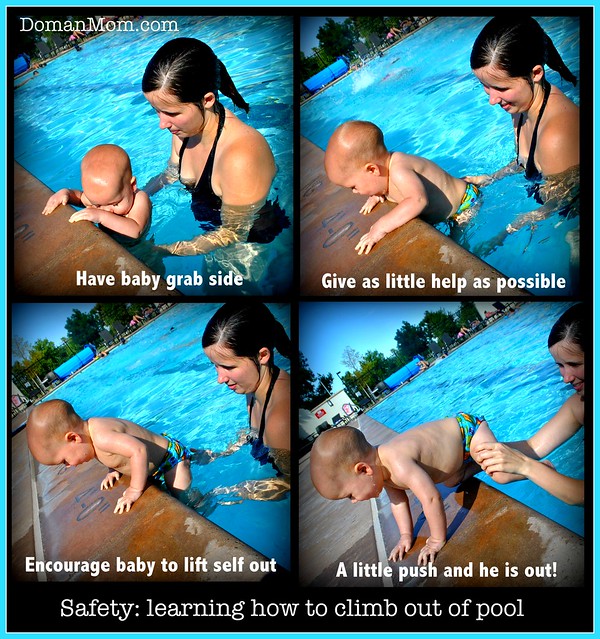
6. Safely exiting the pool
It is very important that your baby learn how to climb out of a pool. Have baby grab the edge of the pool and let him hang on with as little support from you as possible. Let him hang there for a little while. The goal will be to be able to swim to the edge and hang on by himself, and then to eventually be able to hang on and climb out of the pool.
After he has held onto the edge for a little while, tell him to climb out. Give him a little push or let him push off of your hands as needed, by try to let him do as much as possible by himself.
Alterations of this exercise:
  • Swim to a ladder and climb out the ladder
  • Swim to the stairs and climb out from the stairs
  • If you’re in a lake, pond, or ocean, have him swim to the edge of the water and crawl or walk out, or have him hold onto the edge of a dock or climb out a dock ladder
How to Teach Your Baby to Swim
Remember:
1. Always, always, always supervise your baby.It doesn’t matter how good of a swimmer they are – they need adult supervision at all times. Do not become complacent thinking that your baby can save themselves if they fell in. Ever. You need to have the same (or more) vigilance as if they had never seen a pool a day in their life. Drowning is a leading cause of death in young children and 85% of these deaths were completely preventable with proper supervision.
2. Strongly emphasize from day one that baby may never, never enter the pool without you first giving the signal and being right there. Be consistent and they will learn.
3. Be joyous in your teaching! Your baby will pick up on your attitude. Always be enthusiastic, happy, and full of laughter and excitement, even if your baby might be timid. Babies will feed off of your composure.
4. Watch your baby carefully for distress, and never push him beyond slight discomfort. The key is to be gradual and patient. If he does not like something, do the exercise for just a split second and then praise him profusely. Hug him, kiss him, tell him how wonderful he is, and celebrate his accomplishment. Perhaps repeat one more time, then go onto something else. A little bit every day leads to substantial progress over time.
5. If your baby does not enjoy the water at all, do not try and do these exercises until he is comfortable in waterStart small, just by getting him used to walking around in the water while you hold him. Encourage him to splash, watch you get your face wet or blow bubbles, or play with toys. Once he is comfortable, gradually build in more exercises into your routine. The bathtub is also a great place to introduce splashing, bubble blowing, floating on back, and getting their faces a little wet while you rinse them off.
6. Try to swim at least three days a week to achieve the best result. Swimming every day is ideal!
As some encouragement for you, here is a video of my baby I took two days ago of him swimming underwater. If it makes anybody feel better, just a few weeks ago he hated putting his face in the water and would often swallow water whenever I put him under!Now he swims with great joy and even since this video, he has progressed! He now kicks his little feet and swims farther and longer underwater, and he also no longer nose dives to the bottom of the pool but stays relatively near the surface!

Happy swimming! I would love to hear about your experiences and progress with your little ones!

See also, my response to the many queries in the comments about the ISR method for infant swimming: Infant Swimming: The Roll and Float Survival Method (ISR)
Also related: Video and pictures of Damien swimming at 21 months old – Toddler Swimming: Water Play
“The LORD on high is mightier than the noise of many waters, yea, than the mighty waves of the sea.”
Psalm 93: