Tuesday, May 28, 2013

Teaching child how to swim

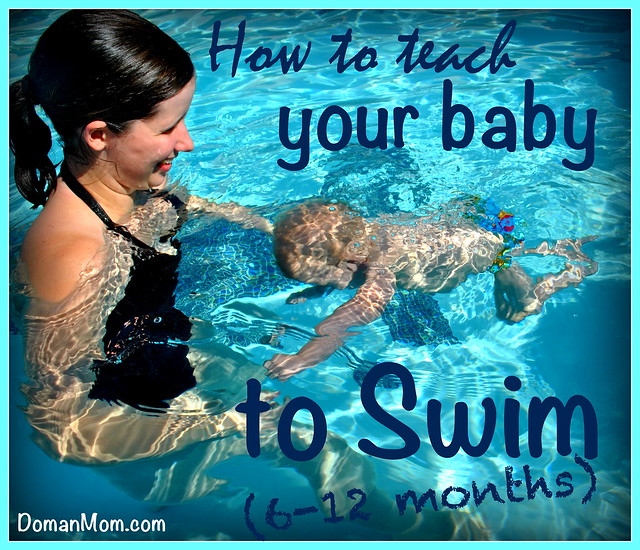
How to Teach Your Baby to Swim
Summer officially began yesterday, but for many of us “summer” has been in swing for weeks or even months now, which hopefully means lots and lots of beneficial swimming!
Our swimming program has been on again, off again since April, but lately has been going great with fabulous progress from both of my boys (ages 1 and 7). In this post, I would like to share with you the exercises I have been using with Damien (12 months) over the past few weeks to teach him how to swim!
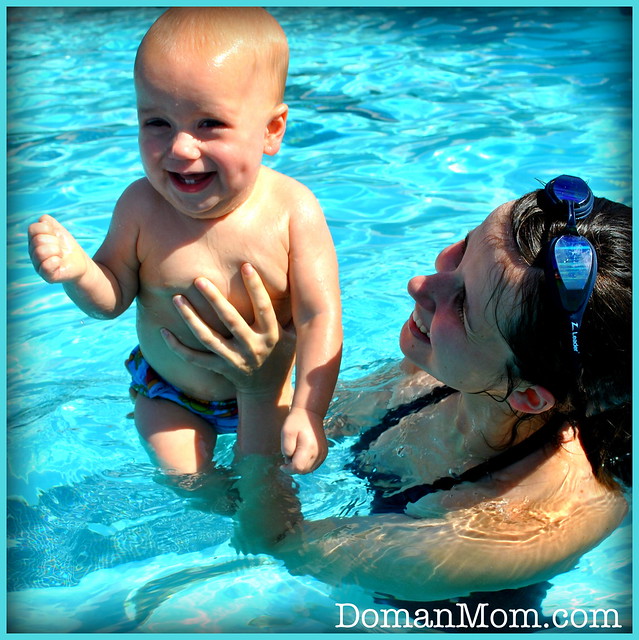
How to Teach Your Baby to Swim
He loves to swim!
I use the techniques as outlined in the Doman book How to Teach Your Baby to Swim – Birth to Age 6. A little about this program:
  • It is not just a “water introduction” program as most “swimming lessons” are for this age. It is actually about teaching your baby to swim, by themselves, beginning at birth or any time thereafter (newborns are born knowing how to swim).
  • The program is gentle and joyous! No aggressive, cry-it-out techniques here.
  • The program emphasizes learning swimming skills, water safety, water hygiene, and bonding with parents.
This 6-12 month old program is the second level of the Doman swimming program (first level is 0-6 months). Some prerequisites to this level of the program:
  • Is ideally familiar with and accustomed to water and pool.
  • Can hold breath underwater
There are a lot more things covered in the first level of the program, but if you have an older baby and are just now beginning, you can jump right into this level of exercises after you first work on getting your baby comfortable in water and knowing how to hold their breath underwater. Some tips for achieving that are found below!
Are you ready for the techniques? Here are some of the exercises we do:
How to Teach Your Baby to Swim
1. Jumping into the pool
This is an important exercise as it is not only laying the foundation for diving later on, but you are also teaching your baby how to safely enter the pool. It’s also an awful lot of fun!
Key: Teach baby to only enter pool with parent!
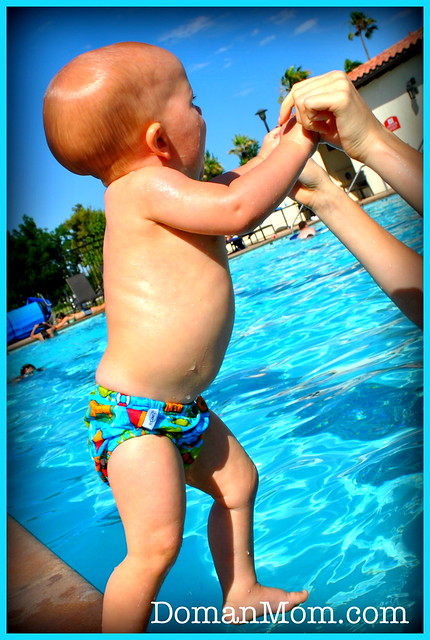
You can do this exercise by first having baby sit at the edge of the pool. Teach him that mommy always goes in first and he must wait. They’re never too young to understand this!Once you are ready, give him permission – “Ok! 1,2,3, jump!” Whatever wording you choose, be consistent and always say that same phrase.
In the beginning you will need to have him hold your fingers with his hands and very gently pull him in. If he is accustomed to going underwater, let him jump in and go under and then pull him up to the surface or let him kick and swim up to the surface.
Beginners: If he’s not yet accustomed to going underwater, just let him go in chin deep and then pull him back up to yourself. Gradually go deeper under as he learns and becomes comfortable!
How to Teach Your Baby to Swim
Jumping from standing
Some alterations of this exercise:
  • Jump in from sitting without holding parent’s fingers
  • Jump in from standing position with or without holding parent’s fingers
Tip: Continue to hold your baby’s fingers until you feel he is very well balanced – slipping is easy and can be dangerous
How to Teach Your Baby To Swim
Playing together underwater
2. Blowing bubbles, bobbing up and down, going underwater together
Blowing bubbles in the water is a great way to teach your baby to hold his breath if he’s not yet accustomed to it. It will teach him to blow out, not breath in, while his mouth is underwater, and will also help him to get comfortable with his face in the water. Babies love to mimic so this is always a lot of fun!
Bobbing up and down is another way to slowly introduce your child to holding his breath. Think of a phrase to use, such as “1,2,3, under!” that means he is about to go under the water, and use it every time without fail!
Always tell your baby when he is about to go under (either a little or fully submerged). He will learn what the phrase means and will hold his breath in anticipation.
At first simply bob him up and down only to chin deep. Keep it fun and joyous! Gradually, over the course of time, get deeper and deeper, first getting just his mouth a little wet with each bob, then submerging his entire mouth, then up past his nose, finally you will get to where his entire face and then entire body goes under with each bob.
Read your baby’s cues – introduce steps gradually and don’t continue if your baby isn’t enjoying himself!
A final exercise in learning to hold his breath will be to go underwater together completely. Do this for just a split second at first and you will gradually be able to stay under longer. Make it fun!
How to Teach Your Baby to Swim
3. Passing underwater
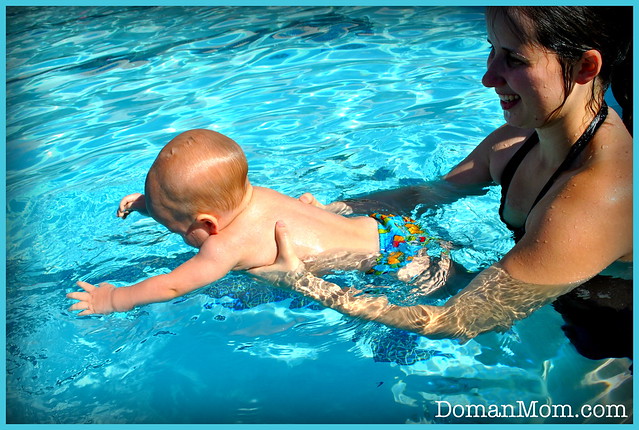
Once your baby is comfortable holding his breath underwater, you can begin to teach him the swimming motions by passing him under the water. Grasp his sides as in the picture above and hold him horizontally in the water. You can either hold him straight out in front of you (as above) or sideways in front of your, or by your side. Then give him to phrase (“1,2,3, under!”) and put him underwater while moving him through the water. Encourage him to kick, kick, kick! This will teach him the forward motions of swimming. As he gets used to this, briefly let him go while you do this exercise.
How to Teach Your Baby to Swim
4. Swimming independently underwater
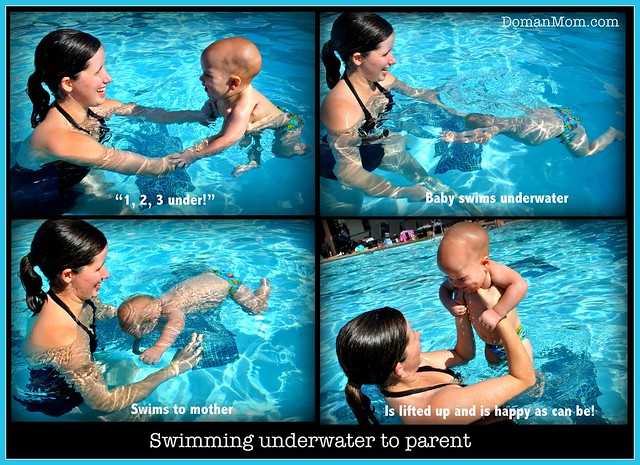
Once your baby is comfortable and confident underwater, he can begin to truly swim! Start by doing the bobbing up and down exercise or the passing underwater exercise, but briefly let go of him while he is underwater. This may startle him at first to feel his own weight floating in the water without your hands supporting him! Just begin slowly and gradually, as with everything.
Next begin to walk backwards in the pool while holding baby by his sides in front of you(see above picture). Give him the signal that he is about to go under (“1, 2, 3, under!”) and let him go. Hold your arms out for him to swim to you. Babies instinctually know how to swim! He may be uncoordinated at first but will get the hang of it quickly.
If he doesn’t fully swim to you, pull him towards you and then lift him out of the water.Praise him profusely! Begin with just split second swim sessions and gradually lengthen the time baby stays underwater as you sense his capabilities.
Walking backwards before you let him go under creates a current and will make it easier for baby to swim to you!
Alterations of this exercise:
  • Have baby swim to you while you are standing still (instead of walking backwards first)
  • Have baby swim between two parents or between a parent and sibling
  • Have baby swim in front of you or beside you (this way you can “push” him through the water before letting him go, giving him a boost)
  • Have baby sit on a stair step or hold onto the ladder or edge and then jump in and swim to you
How to Teach Your Baby to Swim
Back floating is the only thing about swimming he doesn’t yet enjoy
5. Floating on back
By being able to float on their backs, babies can learn to swim, flip over to catch a breath(and/or rest), swim some more, and then catch another breath and continue in this pattern. Most babies will be able to float on their backs long before they are able to lift their heads out of the water.
This exercise is simple – put your baby on his back and help him float! At first hold your baby completely so he feels secure, but gradually decrease the amount of support you give him until eventually he will hopefully be able to float on his own. If baby is uncomfortable in this position at first, you might need to get creative – for instance, lay your baby’s head on your shoulder (at water level) and be playful – have him kick his feet and tickle his tummy! He will gradually become used to the horizontal position.
Try associating a song with back floating – we sing “Twinkle, twinkle little star” (as he looks at the sky). Consistently using specific words, phrases, or even songs for each exercise will teach your baby what to expect and spur his success.
Alterations of this exercise:
  • It is a good idea to teach your baby how to get on their backs from a different position. Flip them gently from their stomach to their back, then back onto their stomach, etc.
  • Help your baby to swim to the surface of the water and then get into the back floating position. 
On a side note, my son hates floating on his back! The child is all smiles the entire time we’re in the pool but becomes very upset whenever I try this with him. I just introduce it in short little bursts and don’t push it when I see he is not enjoying himself. I know, as with everything, he will get it eventually.
How to Teach Your Baby to Swim
6. Safely exiting the pool
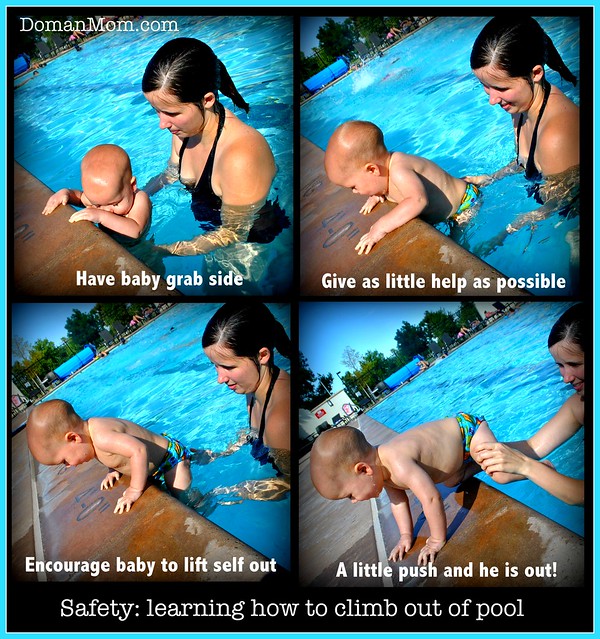
It is very important that your baby learn how to climb out of a pool. Have baby grab the edge of the pool and let him hang on with as little support from you as possible. Let him hang there for a little while. The goal will be to be able to swim to the edge and hang on by himself, and then to eventually be able to hang on and climb out of the pool.
After he has held onto the edge for a little while, tell him to climb out. Give him a little push or let him push off of your hands as needed, by try to let him do as much as possible by himself.
Alterations of this exercise:
  • Swim to a ladder and climb out the ladder
  • Swim to the stairs and climb out from the stairs
  • If you’re in a lake, pond, or ocean, have him swim to the edge of the water and crawl or walk out, or have him hold onto the edge of a dock or climb out a dock ladder
How to Teach Your Baby to Swim
Remember:
1. Always, always, always supervise your baby.It doesn’t matter how good of a swimmer they are – they need adult supervision at all times. Do not become complacent thinking that your baby can save themselves if they fell in. Ever. You need to have the same (or more) vigilance as if they had never seen a pool a day in their life. Drowning is a leading cause of death in young children and 85% of these deaths were completely preventable with proper supervision.
2. Strongly emphasize from day one that baby may never, never enter the pool without you first giving the signal and being right there. Be consistent and they will learn.
3. Be joyous in your teaching! Your baby will pick up on your attitude. Always be enthusiastic, happy, and full of laughter and excitement, even if your baby might be timid. Babies will feed off of your composure.
4. Watch your baby carefully for distress, and never push him beyond slight discomfort. The key is to be gradual and patient. If he does not like something, do the exercise for just a split second and then praise him profusely. Hug him, kiss him, tell him how wonderful he is, and celebrate his accomplishment. Perhaps repeat one more time, then go onto something else. A little bit every day leads to substantial progress over time.
5. If your baby does not enjoy the water at all, do not try and do these exercises until he is comfortable in water. Start small, just by getting him used to walking around in the water while you hold him. Encourage him to splash, watch you get your face wet or blow bubbles, or play with toys. Once he is comfortable, gradually build in more exercises into your routine. The bathtub is also a great place to introduce splashing, bubble blowing, floating on back, and getting their faces a little wet while you rinse them off.
6. Try to swim at least three days a week to achieve the best result. Swimming every day is ideal!
As some encouragement for you, here is a video of my baby I took two days ago of him swimming underwater. If it makes anybody feel better, just a few weeks ago he hated putting his face in the water and would often swallow water whenever I put him under!Now he swims with great joy and even since this video, he has progressed! He now kicks his little feet and swims farther and longer underwater, and he also no longer nose dives to the bottom of the pool but stays relatively near the surface!

Happy swimming! I would love to hear about your experiences and progress with your little ones!

See also, my response to the many queries in the comments about the ISR method for infant swimming: Infant Swimming: The Roll and Float Survival Method (ISR)
Also related: Video and pictures of Damien swimming at 21 months old – Toddler Swimming: Water Play
“The LORD on high is mightier than the noise of many waters, yea, than the mighty waves of the sea.”
Psalm 93:

Sunday, April 28, 2013

Right Now: Eli 7 Months!


You sir are the cutest little guy. Your gummy smile brings me such joy. You are now crawling somewhat backwards and turn in circles. You are grabbing things and focused on what you want. You have gorgeous hair and your eyes just look deep into people. 

You do enjoying speaking and babbling but spend a lot of time simply observing your environment. You're fully into vegetables and eating stage 2 foods. You, of course love any fruits we give to you. You're doing better with us simply laying you down and not quite rocking you anymore. You laugh a lot at Ian. Your favorite pacifer is all of them! You are in the 28th percentile with weight and 85th percentile in height - LONG BABY!

Love you bugs!


Wishlist: Art Journaling Supplies


* craft mat - babble or ranger brands (you can heat things on it as well)
* heat gun (for drying paint colors)
* braier
* mat-medium

Saturday, April 20, 2013

Right Now: Ian

Mr. Ian I don't write about you nearly enough and yet you have said so much in the last 6 months and grown so much!

Your favorite movie at one point: (you claimed) was Stars Wars....the Teenage Mutant Ninja Turtles

Your favorite food: Mac'n Cheese or green peppers and hummus

Your favorite pajamas: anything superhero

Your favorite song: Skillet's "Superhero" song

You love to "race" anything and to play outside any chance you have. You are hilarious and ask for "special things". You are the most wonderful big brother to Elijah and listen very well to how you can care for him and hold him.


You showing your art yesterday... :)

101 Amazingly Awesome Things to do with Your Preschooler.


I took this post from here.
1. Pick dandelions and sort them by blossom size - they get "flowers" and you get free weeding! Put them in a little glass of water on the dining room table.

2. Cook spaghetti together. Let your child pour in the sauce, pour water (from a pitcher) into the pot, and break the noodles.

3. Paint on a canvas.

4. Open a blank document and let them type words that you spell for them (or their name) on your computer.

5. Lie outside on a blanket and point out shapes in the clouds.

6. Take a plastic baggie on a nature walk, and ask your child to find ten different things. Lay out the collection of found nature objects and compare their shapes, colors, textures, and smells.

7. Make sidewalk chalk art. Teach your child how to play hopscotch!

8. Dye eggs. (Who says you have to wait for Easter?)

9. Play "I Spy" with letters of the alphabet and/or household objects ("I spy something that starts with the letter 'W'" or "I spy something that plugs in,")

10. Sort something by color together (clothes, toys, books, etc).

11. Go to a hardware store and pick out a bunch of paint chip strips. Cut out the squares and glue pairs of them back-to-back on a length of string to make a paint chip garland (the string should be between the back-to-back paint chip pieces when you glue them together).

12. Play "Follow the leader."

13. Look at old photos and point out friends and family members. Talk about how they are different now.

14. Eat a spoonful of peanut butter. Or Nutella. Or something else that should probably be forbidden to be eaten by the spoonful. Pretend it's an extra special amazing treat and you're only giving it to them because you're the best mom (or dad) ever.

15. Move the living room furniture, put blankets and pillows on the floor, pop popcorn, and watch a movie.

16. Have a family game night...stack up games like Candy Land, Guess Who?, and Chutes and Ladders, and play until bed time.

17. Teach your child how to use your camera (or get them one of their own), and let them take a picture of you. Print it, frame it, and put it in their room.

18. Put on jeans and long-sleeve shirts and roll down a hill together.

19. Tell a story about when they were a baby.

20. Tell a story about when YOU were a baby.

21. Pull up blades of grass and sort them from smallest to tallest. Practice whistling through grass.

22. Teach them how to taste honeysuckle.

23. Sort jewelry by color, then re-sort by type.

24. Line up the stuffed animals on the sofa in the living room, give your kiddo a microphone (or a hairbrush, or a magic wand), and let them perform their favorite song.

25. Throw a sheet over the dining room table and make a fort underneath.

26. Match socks. Use the leftover ones to make sock puppets.

27. Have a conversation with them that aims at teaching them something. Talk about the function of the dishwasher as you unload it ("What do you think this does with the dishes?") or about why the ice in their drink melts when you pour them a glass of water ("Do you think the ice will stay in there forever? Will it melt? Why?")

28. Make music out of kitchen utensils.

29. Ask your child what their favorite animal is, what they think it eats, where they think it lives, etc. Then let them help you figure out what letter their animal starts with, ask them to help you find that letter encyclopedia, and look it up (yeah...like in a book.). Show them a picture of their animal and read them some interesting information.

30. Go to a park that has a playground and give them a quest ("Let's pretend that play structure is a ship!")

31. Go to a park without a playground. Take a ball or a bike.

32. Blow bubbles and try to catch them on the wand as they fall without making them pop.

33. Let your child cut the letters of their name out of a magazine with safety scissors and paste the letters (in order) onto paper.

34. Let your child cut out "things they love" in a magazine with safety scissors and use them to make a collage. Parenting magazines and magazines specifically for kids are great for this!

35. Have a tickle fight.

36. Have a pillow fight.

37. Roll your kids up in blankets and pretend they're cocoons. See who can get out of their cocoon first and turn into a butterfly.

38. Put on relaxing music and do some yoga together...or pretend to do some yoga together. They'll never know the difference.

39. Play with play dough.

40. Spell words and play word games with magnetic letters ("Which one spells 'Daddy?' Is this word 'cat' or 'bat?'").

41. Go outside and spin in circles until you get dizzy and fall over...it's fun to watch kids walk after this.

42. Make a sensory box out of dry rice or beans and a shallow plastic container with a lid. Use funnels, measuring cups, and other containers to play in the box.

43. Spray shaving cream on a cookie sheet and write, draw, and sculpt with it.

44. Put six clear glasses on a table. Put a half cup of water in three of them - one with several drops of red food coloring, one with blue food coloring, and one with yellow food coloring. Use the empty three glasses to figure out what colors red+blue, blue+yellow, and yellow+red make when they are mixed together.

45. Shine a flashlight onto the wall in a dark room and make shadow puppets.

46. Let your kid pick out (or make) thank you notes and then USE them.

47. Show your child how to read the numbers on the digital clock on the cable box or the microwave (super helpful with keeping morning routines on track!).

48. Cut shapes out of construction paper, and then give your child school glue and dictate a sequence to them ("first, glue the big yellow square in the middle of the page, now glue the red circle to the top of the square, and now put the three little blue triangles inside the square"). Praise them for their ability to follow directions well. Praise yourself for reinforcing shapes, colors, patience, fine motor skills, and following directions all in the same activity.

49. Make letter shapes with your bodies.

50. Introduce your kid to classical music while riding in the car (You know...the station is always something like 89.7 or 90.5...you'll find it). Ask them questions about the music, ("Do you hear the violin? The flute is making this sound [insert your best flute imitation here]").

51. Commission a piece of artwork. ("Can you draw a picture of our family with your crayons?"). Once it's done, find somewhere prominent to hang it in your house.

52. Take a trip to the library for story time or to pick out books. Explain how libraries work.

53. Look up free activities in your area (things like "Touch a Truck" where kids can meet firemen and construction workers, or town park nights, or seasonal festivals).

54. Go to a baseball game...eat a hot dog.

55. Have your child pick out seeds for something (a vegetable, a flower, etc.). Help them plant it, take care of it, and watch it grow. If it's a veggie, reap and eat it!

56. Skype with a friend, a grandparent, or someone else who is far away.

57. Go to an antique store and peruse. Point out things that "used to be" to your kid...they'll be amazed that there was ever a world where rotary phones existed (and cellular phones didn't).

58. Play hide and seek or indoor flashlight tag.

59. Make bean bags (or rice bags) for a bean bag toss game. Use a hula hoop, bucket, or bowl for the goal.

60. Take a bucket of water and a paintbrush outside. Paint sidewalk art with water.

61. Make an easy indoor scavenger hunt ("Find a coaster, a bracelet, a crayon, and a sock!")

62. Make an easy outdoor scavenger hunt ("Find a pine cone, a flower, a rock, and a leaf!")

63. Go to a Lowe's or Home Depot kids' DIY clinic. (Click on the links for more info).

64. Hang a prism in the window and watch the rainbows.

65. Throw a pile of pillows blankets, and stuffed animals onto the floor and jump into them (the rainy day version of jumping into a pile of leaves).

66. Create a series of physical challenges ("first do a somersault, then do four jumping jacks, next crawl to that tree, and then run to the fence.")

67. Play charades using props.

68. Go to the farmers market. Make sure your kid will never embarrass you by not knowing what a potato looks like before it turns into French fries. ("that vegetable is an eggplant - see how shiny and purple it is? Is it bigger or smaller than the yellow squash? Which vegetable should we take home tonight to cook for dinner? Will you help me make it?")

69. Picnic in a park...or in your back yard. Let your child help you make sandwiches and pack juice boxes and count grapes as you put them into plastic baggies.

70. Get various (safe) items from around your house (a favorite stuffed animal, the remote control, a book, a crayon), blindfold your child, and then let them try to guess what the thing is just by touching it. Take turns!

71. Make a beaded necklace out of a piece of string (or jewelry elastic) and some beads.

72. "Tight Rope Walk" on the curb (safely please).

73. Taste and smell the spices on the spice rack (only use a speck if tasting...a little goes a long way). Ask questions about the spices ("Which one smelled sweeter: the cinnamon, or the garlic powder?")

74. Cut out and decorate a mask using the cardboard from the inside of an empty box of cereal. Tie it around their face with string or elastic.

75. Limbo with a broomstick.

76. Play indoor Marco Polo - crawl on the floor instead of swimming.

77. Find your town on a map or a globe. ("Where does Grandma live? Where was Daddy born?")

78. Play high/low. ("What is the best thing that happened to you today? What's the worst? What is the best part about being a big brother? What's the worst part?"). Encourage conversation that stems from these questions.

79. Build a bird feeder together. Cover a pine cone with peanut butter, roll it in bird seed, hang it from a tree, and watch for birds.

80. Tell your child five reasons why you think they're the best kid ever.

81. Point out things in your house that are in the shape of a circle, square, rectangle, triangle, etc. ("How many circle shapes do you see on the ceiling? What is the shape of this pillow? Let's put all of the square pillows in this pile and all of the rectangle pillows in this one!")

82. Turn off the TV.

83. Play big band music and dance around the living room.

84. Let your child pick out a new toy that they want, and then tell them that they have to earn the money to get it. Encourage them to do chores or help them take a photo of an old toy and put it up for sale on Craig's List or Ebay. Once the item is sold, help them take it to the post office and ship it. Make sure you remind them along the way what their "goal toy" is so that they'll remember why they're doing all this work.

85. Pretend to be statues. Tell your child to stand really still and see if you can get them to move without touching them/tickling them, etc. Take turns!

86. Go to a pet store and look at the dogs, cats, rabbits, guinea pigs, parakeets, goldfish, lizards, and hamsters. Talk about all the different types of animals that can be pets. Ask to hold them. Which ones are soft? Which ones are friendly? Which ones are the easiest to take care of?

87. Practice fine motor skills like buttoning, zipping, tying, buckling, fastening, and snapping. Cut up old clothes and put the fine motor pieces into a storage container to keep on hand so that your child can play/practice.

88. Put on old clothes, go outside with your child, and tell them to get as dirty as possible...you don't want to see a speck of clean on them when they're done playing.

89. Pretend you're just meeting your child and practice shaking hands. Please teach them to grasp firmly and make eye contact. It's never too early to learn, and they'll feel grown up while they're practicing.

90. Play the rhyming game. Think of a word and then take turns thinking of rhyming words...even if they're made up words, they still count! Read a Dr. Seuss book for ideas...

91. Ask your child to put together a donation box of old toys, and then take it to Goodwill or the Salvation Army (or your favorite donation center), and let your child give the box away themselves. Explain the significance of donating, and walk around the store...maybe you'll find something awesome!

92. Pick out three piggy banks for your child. Paint them, decorate them, or just purchase and use pre-decorated ones. Tell them that one is for saving, one is for spending, and one is for giving. Give your child a stack of quarters, dimes, and nickels, and let them figure out how to split their stash among their banks. Define "saving," "spending," and "giving."

93. Make patterns. Use a stash of buttons, silverware, legos, or anything you can find that has multiple matching pieces. Start laying out a pattern (i.e., yellow button, blue button, blue button, yellow button, blue button, blue button), and let your child try to finish the pattern once you've gotten it started.

94. Make a paper target by tracing circles onto paper in a variety of sizes (use plates, cups, and bowls for an easy pattern), and hang it on the refrigerator. Toss plain magnets at it and see who can get closest to the bulls eye.

95. Bake cookies from scratch.

96. Visit a local petting zoo.

97. Lie outside in the grass, close your eyes, and talk about what you hear instead of what you see (birds? wind? cars?).

98. Put on gloves, grab a trash bag, and pick up litter around your neighborhood (keep a close eye on kids for this one).

99. Build a terrarium together.

100. Host a neighborhood park night - let your child help you with the flyers, bring a case of juice boxes, and let the playground equipment do the rest of the work.

101. Create a treasure map and go on a treasure hunt. Make sure the treasure is worth the quest! Bonus for dressing up like pirates.

Sunday, April 7, 2013

Allowing myself to....

TWEET


to have a smartphone....

to find new apps for my Kindlefire...

to also have a laptop to type of more of my thoughts...

I somehow always vowed that I would not be one of "those" connected people...with all the tech devices but now that I'm discovering what you can do with them - I am pretty excited. Such as, each device hold various versions of the Bible on it and I can take it anywhere including in my pocket!

I can look up most anything, I can see my emails if I desire to. But I can also be intentional and put the devices down and pretend that I don't have them an do everyday normal stuff too.

to totally be excited about the weather NOW even if a snow storm comes tomorrow...

to take oodles of picture and videos of Eli and Ian!!!

to dream about this craft room and having people over...

to eat the huge piece of Butterfinger cake that Emily Dodd made for Caleb Christman's birthday last night!!  LOVE IT!

to be ok with myself in this moment.

Saturday, March 30, 2013

Run-on status: Thoughts

Did my 8 mile run this morning and it's amazing how many thoughts one person can have in that amount of time!

Ran through our neighborhood to 25A here in Troy and then on to Miami River Recreation Trail for the rest. I got to Tipp City and turned around. Through that time, my thoughts ranged from: mentoring,
to someday doing therapy again,
to the sound of the river beside me (LOVE THAT SOUND),
to how much I miss doing this,
to what really is my favorite song, phrase, color, verse,
to what I might say in my talk about Depression & Emotional Resilience coming up,
to how much I miss my parents and my "tree" back home,
to how I can't wait to have Ian and Eli along with me someday,
to isn't this 3 minutes of running over quite yet for a walk,
to I have such a great husband-wish he was with me right now,
to I can't wait to ride my bike on this trail and go into Dayton,
to what if I trained for an Ironman while working full-time and ride my bike into work and then back (how long would that take?)
to I love this jacket,
to I want to beat the pace of the runner who I just saw,
to I wish I was in better shape to go faster,
to pretty shoes!,
to I can't wait to run with Rachel Harvey in her first half marathon,
to "WOW, I'm back to training for this half marathon in just 5 weeks like I did last post-pregnancy,"
to thank you to my Heavenly Father for the gift of movement,
to being grateful for my relationship with my Savior,
to going through the timeline of this past year: moving, job, friends, baby, moving again, life.

If my body could take it all the time, I'd run all the time but it can't take it. So...triathlon again?